How We Improved Bracket 5 Detection
August 13, 2026
Player feedback exposed a gap in how ScryCheck distinguished high-powered Commander decks from cEDH decks. We added current tournament data to the scoring engine, then tested the change against 5,766 existing Bracket 5 analyses.
The accuracy problem
A player wrote in about their Celes, Blood Arbiter deck. ScryCheck had it at Bracket 5, but the player expected Bracket 4. The deck was optimized and capable of winning consistently, but neither the commander nor the list reflected the current cEDH metagame. That link now shows the corrected Bracket 4 result described below.
That distinction mattered. Our engine was good at identifying powerful decks: compact win conditions, tutors, fast mana, interaction, and early win potential all contributed to the score. But those signals alone could push a highly tuned casual deck into Bracket 5.
The rating was defensible as a measure of power, but it was not an accurate Bracket 5 assignment. The player’s feedback gave us a useful case to investigate rather than a one-off override to make.
Adding the missing metagame signal
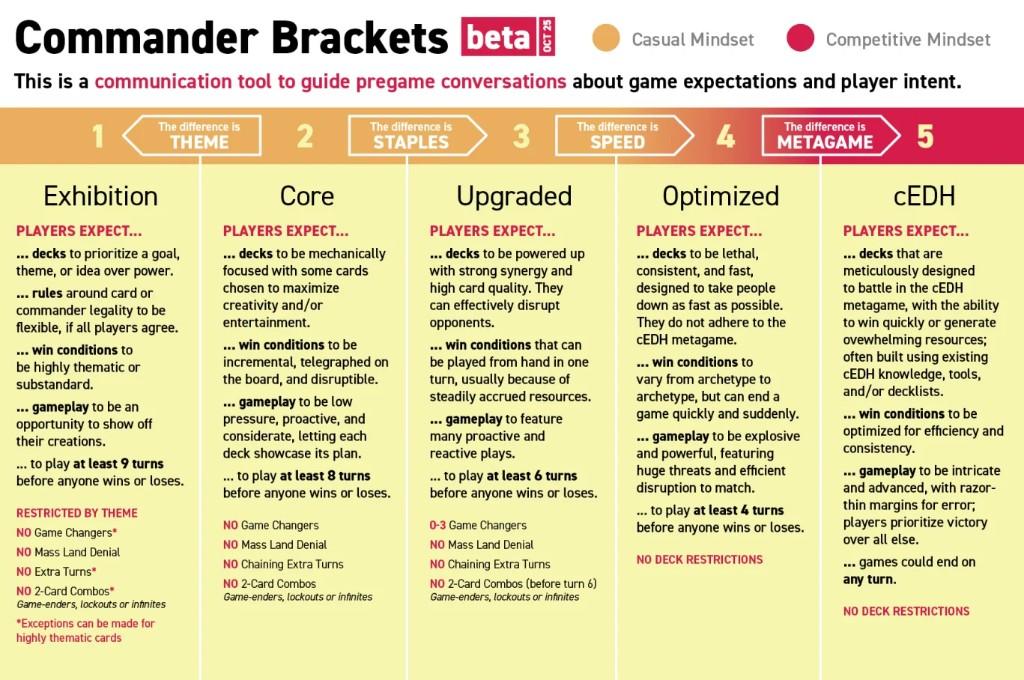
We went back to Wizards’ bracket guidance. Its chart describes the transition from Bracket 3 to Bracket 4 in terms of speed, while the transition from Bracket 4 to Bracket 5 is labeled metagame. Bracket 4 is already allowed to be fast, consistent, and unrestricted.
We interpret that boundary to mean that a Bracket 5 result needs more than a high power score. The deck should also resemble lists built for the cEDH tournament environment. Our previous model did not have a reliable, current way to test that.
The size of the existing Bracket 5 population supported that concern. Bracket 5 represented 6.5% of analyzed decks, far more than we would expect for genuine cEDH lists. We needed a separate metagame check rather than another adjustment to the power formula.
Why a list of powerful cards was not enough
Our first attempt used a hand-curated list of competitive staples. It improved some results, but it also revealed a basic problem: a powerful card is not necessarily evidence of cEDH deck construction.
Sol Ring appears in 45.3% of tournament decklists and 84.2% of the casual decks in our sample. It is powerful and widely played, but it does not help distinguish the two groups. Arcane Signet has the same problem.
We changed the question from “Is this card strong?” to “Is this card disproportionately played in cEDH?” We measure that with lift: a card’s tournament play rate divided by its casual play rate.
Greyed rows fail the lift test and never enter the pool. Sol Ring and Arcane Signet are more common in casual decks than tournament ones — their lift is below 1.
Mental Misstep is a strong example. It appears in 87% of tournament decks and 0.2% of casual decks. Its value depends heavily on the spells it is expected to answer, so it carries much more information about the metagame than a broadly useful staple does.
Swords to Plowshares shows the opposite case. It sees more tournament play than Sol Ring, but it is common enough in casual white decks that it does not meet the lift threshold. Card quality and metagame relevance remain separate signals in the engine.
Keeping the model current
A hand-curated staple list also becomes outdated. Bans, new commanders, and new strategies change which cards define cEDH. A static list would require frequent subjective maintenance and could drift without an obvious failure.
The new pool is generated from data each week. We pull tournament play rates from edhtop16, compare them against a 12,000-deck sample of our own Bracket 1–3 corpus, and retain cards that meet minimum tournament play-rate and lift thresholds. Of the 1,334 cards currently returned by the tournament source, 228 meet both requirements.
A deck is scored against the eligible cards in its own color identity, with each match weighted by tournament play rate. This avoids penalizing mono-color and colorless decks for staples they cannot legally run. It also corrected an early version of the model that underrated a known competitive Eladamri elfball list.
We also version the generated pool. When score-relevant tournament data changes, the scoring version changes with it so cached deck analyses are recalculated instead of retaining an older metagame result.
Validating the change
We calibrated the threshold against known cases on each side of the boundary, including the Celes list that prompted the review and an independently labeled cEDH Eladamri list. We then applied the proposed 52% baseline threshold to every existing Bracket 5 analysis.
Because the change affected a substantial share of existing Bracket 5 analyses, the distribution by commander was an important validation check.
Share of each commander’s Bracket 5 decks that stayed Bracket 5 under the new test.
Established tournament shells were retained at high rates. Rograkh and Silas Renn kept all 59 existing Bracket 5 assignments, Tymna and Kraum kept all 31, and Vivi Ornitier kept 159 of 173.
Commanders with many optimized casual lists moved in the other direction. Koma, Cosmos Serpent retained one of 247 Bracket 5 assignments, while Adrix and Nev retained none of 78. These decks did not lose power points; the additional signal changed whether their power profile was sufficient for a Bracket 5 label.
This result matched the problem we were trying to solve: preserve cEDH lists while reducing Bracket 5 assignments for strong decks that do not resemble the current competitive field.
A known limitation
Metagame adherence correlates with deck price, at a Spearman’s rho of 0.72 across the decks we tested. Some of that is unavoidable: many of the cards that define the paper cEDH metagame are old and scarce, so any measurement of that card pool carries price information with it.
Price is not an input to the model. Adherence is calculated only from tournament play rates, and we exclude lands from scoring because original duals and other staple lands combine a strong tournament signal with an unusually direct budget signal.
It is not a price gate, and inexpensive decks do clear the threshold. But the relationship is stronger than we would prefer, and reducing it is something we will keep measuring as we tune the model.
What this means for a deck analysis
| Replay outcome | Decks | Share |
|---|---|---|
| Remained Bracket 5 | 2,738 | 47.5% |
| Moved to Bracket 4 | 3,028 | 52.5% |
| Total tested | 5,766 | — |
For 3,028 of the 5,766 decks tested, the new metagame check changed the result from Bracket 5 to Bracket 4. Across the full corpus, that moves Bracket 5 from 6.5% of all analyses to roughly 3.1%, much closer to the share we would expect for genuine cEDH lists.
Those decks have not been assigned a lower power score. The check only affects Bracket 5 eligibility after the rest of the analysis determines that the deck has enough strategic ceiling to reach it.
This lets ScryCheck preserve useful distinctions among high-powered decks. A Bracket 4 deck can still have a very high power level, fast win potential, and unrestricted card choices. The revised bracket result says that the list does not currently meet the additional metagame-adherence requirement we use for Bracket 5.
This is a meaningful improvement, but not a final answer. The cEDH metagame will keep changing, the price relationship needs continued scrutiny, and player feedback will continue to surface cases that aggregate validation misses.
The full method, including the current threshold and how the pool is rebuilt, is in the docs. If an analysis still looks wrong, the feedback form on the deck page remains the most useful way to tell us. This update began with one of those reports.